

SEBI Circular on Digital Accessibility Clarification
Published on: 19/12/2025
Contents
- Why SEBI Is Strengthening Digital Accessibility
- What the 2025 Circular Requires: Key Compliance Actions
- Who Reports to Whom: Accountability Framework (Annexure A Clarified)
- Why SEBI Guidelines Matter — for Investor Rights and Market Integrity
- What Regulated Entities Should Do Immediately — Action Plan
- Why Early Action Matters — Risk & Compliance Lens
- How AccessifyLabs Helps Regulated Entities Comply — Real-World Digital Accessibility Solutions
- Don’t Wait to Act


Summary
December 8, 2025, SEBI’s circular establishes digital accessibility as an investor right, requiring all Regulated Entities (REs) to comply with WCAG 2.1 AA standards, submit accessibility readiness reports by March 31, 2026, and undergo periodic audits by certified accessibility professionals. The guidelines aim to ensure barrier-free access, strengthen investor protection, and enhance market transparency.
Summarize full blog with:


India’s financial sector is rapidly transitioning to a fully digital model. Recognizing this shift, SEBI has issued a clarification (December 8, 2025), reinforcing that digital accessibility is not optional; it is an investor’s right. This digital accessibility news highlights the urgency for all regulated entities (REs) to assess, audit, and report the accessibility readiness of their digital platforms by March 31, 2026. For many institutions, this deadline demands immediate action. This blog outlines what SEBI now requires and how AccessifyLabs’ digital accessibility solutions can help REs meet the mandate smoothly.
Why SEBI Is Strengthening Digital Accessibility
From a risk perspective, lack of accessibility can lead to compliance failures, investor complaints, reputational damage, and regulatory consequences. For REs, proactive accessibility compliance is not just ethical; it is now a legal and operational necessity.
The financial market ecosystem depends heavily on digital infrastructure, including trading portals, mobile apps, investor dashboards, e-KYC, and online disclosures. With rising online participation, especially among retail and first-time investors, any barrier within these digital touchpoints can deny access. SEBI’s move reflects a broader intent to ensure market integrity, investor protection, and inclusive access for all, including persons with disabilities. Digital accessibility is now a fundamental investor right. From a risk perspective, gaps in accessibility can lead to compliance failures, investor complaints, reputational damage, and regulatory consequences. For REs, proactive accessibility compliance is no longer optional but a legal and operational requirement.
Digital Accessibility Confirmed as Investor Right
In a landmark update, SEBI’s 2025 circular formalizes “accessibility” as part of the Investor Charter for all regulated entities. This recognition transforms accessibility from a compliance checkbox to a core investor entitlement. Under this framework:
-
Investors with disabilities must have the same seamless digital access as other users.
-
REs are accountable: digital platforms must meet global accessibility standards.
-
Accessibility issues can be raised via complaint channels, and REs are obliged to remediate them.
This step aligns India’s financial sector with global trends, where user rights, inclusivity, and regulatory compliance go hand-in-hand.
WCAG has become the benchmark for web accessibility worldwide. Many legal regulations, like the Americans with Disabilities Act (ADA) and the European Accessibility Act, rely on WCAG as the standard for compliance.
What the 2025 Circular Requires: Key Compliance Actions
1. New Deadline for Auditor Engagement & Readiness Report
Original deadlines have been extended. Instead of an auditor appointment by December 14, 2025, REs must now submit a full readiness and compliance status by March 31, 2026.
This provides a short window to assess all digital properties, plan audits, and remediate critical issues.
2. Mandatory Accessibility Readiness Report (Annexure B Format)
SEBI’s prescribed reporting format (Annexure B) requires REs to:
-
List every investor-facing digital platform (websites, mobile apps, portals).
-
Declare whether each platform meets AA-level accessibility (WCAG 2.1/2.2) or equivalent standards.
-
Provide status remarks, i.e., “compliant,” “partially compliant,” or “pending remediation.”
Standardized reporting enables SEBI to benchmark accessibility compliance across the ecosystem and ensures transparency.
3. New Complaint Channel “Accessibility” on SCORES
SEBI has added “Accessibility” as a complaint category on its SCORES portal. Investors can log accessibility-related grievances, and REs must remediate issues before closure. This increases regulatory accountability and pushes REs to prioritize accessibility fixes and strong governance.
4. Mandatory Periodic Accessibility Audits by Certified Professionals
The circular mandates that all digital platforms, websites, mobile apps, and portals undergo periodic audits by qualified accessibility professionals. This moves REs beyond sporadic checks to establishing recurring accessibility compliance processes.
Who Reports to Whom: Accountability Framework (Annexure A Clarified)
SEBI has defined a structured reporting architecture so every RE knows where to submit their compliance documentation:
-
Stock brokers & depository participants → Stock Exchanges / Depositories
-
Investment Advisers & Research Analysts → BSE Ltd.
-
Other REs (Mutual Funds, AMCs, MIIs, clearing corps, etc.) → Directly to SEBI This ensures consistent oversight and clarity in compliance workflows.
Why SEBI Guidelines Matter — for Investor Rights and Market Integrity
-
From Optional to Mandatory: Digital accessibility is no longer an optional enhancement; it’s a regulatory requirement.
-
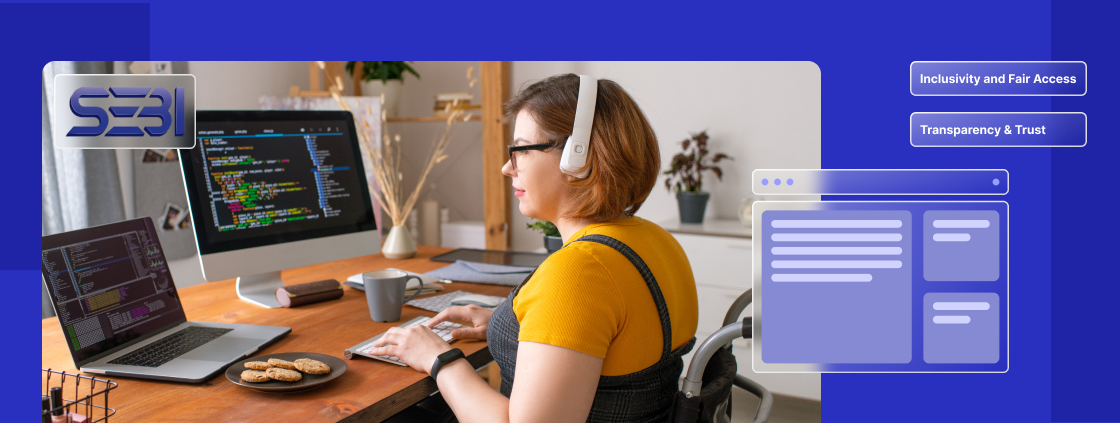
Inclusivity and Fair Access: Investors with disabilities have equal rights to access trading, disclosures, statements, and KYC, removing systemic barriers.
-
Transparency & Trust: Standardized reporting, audit-based compliance, and complaint redressal strengthen investor confidence.
-
Regulatory & Legal Risk Management: Non-compliance can lead to grievances, reputational damage, and litigation. Proactive compliance reduces long-term exposure.
-
Sustainable Digital Accessibility Solutions: REs must adopt frameworks and processes that ensure long-term compliance, not one-time fixes.
For regulated entities, large or small, aligning with SEBI’s digital accessibility requirements is now a cornerstone of responsible, inclusive, and compliant digital governance.
What Regulated Entities Should Do Immediately — Action Plan
| Step | Task |
|---|---|
| 1 | Conduct a comprehensive WCAG 2.1/2.2 AA gap assessment for all investor-facing platforms. |
| 2 | Begin digital accessibility testing: manual audits, assistive technology testing, and automated scans. |
| 3 | Though SEBI does not require reporting the status of the auditor’s appointment, the critical point is that REs must submit the Readiness and Compliance Report (Annexure B) by March 31, 2026 — something that cannot be completed without having the auditor appointment finalized. |
| 4 | Build an accessibility roadmap prioritizing critical issues, remediation timeline, and ongoing QA. |
| 5 | Prepare to submit the readiness & compliance report (Annexure B) by March 31, 2026. |
| 6 | Train product, development, QA, and compliance teams on accessibility standards and workflows. |
| 7 | Establish internal workflows to address SCORES accessibility complaints, remediation, verification, and closure. |
Implementing these steps with discipline will not only meet SEBI’s deadlines but also embed accessibility as a sustainable, long-term practice, reducing risk and improving usability for all investors.
Why Early Action Matters — Risk & Compliance Lens
Delaying compliance exposes REs to multiple risks:
-
Accessibility complaints from investors
-
Audit findings and regulatory scrutiny
-
Reputational damage, loss of trust
-
Costly retroactive remediation if digital platforms scale
-
Business disruption, especially for critical processes such as KYC, trades, and reports
Adopting a shift-left accessibility approach, addressing accessibility early in design, development, and release cycles, reduces long-term cost, supports smoother compliance, and builds a foundation for inclusive digital growth.
How AccessifyLabs Helps Regulated Entities Comply — Real-World Digital Accessibility Solutions
AccessifyLabs offers a comprehensive and enterprise-ready suite of services that align directly with SEBI’s 2025 mandates:
1. Certified Accessibility Auditing & Testing Teams
Our auditors are trained and experienced in global standards (WCAG 2.1/2.2, EN 301 549), perform assistive-technology testing, manual audits, and real-user evaluations. This ensures high accuracy and reliability in audit results.
2. Full-spectrum Digital Accessibility Audits (All Platforms Covered) We audit:
-
Websites and web portals
-
Mobile apps (iOS / Android)
-
Investor dashboards and trading portals
-
PDF documents and statements
-
Multimedia content and interactive user flows
This wide coverage ensures no digital asset is left untested.
3. Hybrid Testing Methodology: Human + Automation + AT
We combine manual evaluations with usability testing conducted by real users with disabilities, assistive-technology testing (screen readers, magnifiers, keyboard navigation, voice), and selective automation to identify issues tools alone cannot detect. This hybrid framework delivers comprehensive and reliable compliance validation.
4. Actionable, Compliance-Ready Reports
Our deliverables include:
-
WCAG mapping and compliance status per guideline
-
Screenshots/code snippets for developers
-
Severity scoring, impact assessment, and remediation priority
-
Annexure-ready summaries for SEBI reporting
This makes our audits directly usable for readiness reporting and remediation planning.
5. Continuous Monitoring to Avoid Regressions
Accessibility is not a one-time fix. We provide:
-
Quarterly or periodic pulse-checks
-
Automated monitoring with expert review
-
Regression testing on every release or update
-
Assistance in integrating accessibility QA into release pipelines
This ensures long-term compliance and proactive issue prevention.
6. Governance & Capability Building
We support internal capacity building through:
-
Developer and QA training on accessibility best practices
-
Accessibility playbooks aligned to your workflows
-
Governance frameworks to embed accessibility into the process, design, and product lifecycle
This helps REs move from one-time audit compliance to sustainable, mature digital accessibility programs.
Don’t Wait to Act
SEBI’s December 8, 2025 clarification marks a turning point for digital accessibility in India’s financial sector. For regulated entities, it demands more than a one-time compliance exercise: it requires robust processes, technical discipline, and long-term governance.
With investor rights, complaint mechanisms, mandatory audits, and compliance deadlines all in place, REs must treat this as a core regulatory priority.
For those ready to meet the challenge, AccessifyLabs offers proven, enterprise-grade digital accessibility solutions, bridging strategy, audit readiness, remediation, and long-term compliance. Acting sooner rather than later is not just safe; it’s the clear path to inclusive, compliant, and future‑proof digital platforms.
Stay ahead of SEBI’s mandate.
Partner with AccessifyLabs to audit, remediate, and future-proof your digital platforms with confidence.
Ready to make your digital products accessible to everyone?
Don’t wait for issues to surface post-launch. AccessifyLabs can help you integrate accessibility testing into your development lifecycle, combining automated tools with expert-led validation to ensure compliance, usability, and a truly inclusive digital experience.
Frequently Asked Questions
Design systems amplify both good and bad accessibility. Tools in this category test reusable components, states, and patterns before widespread adoption.
Design systems amplify both good and bad accessibility. Tools in this category test reusable components, states, and patterns before widespread adoption.
Design systems amplify both good and bad accessibility. Tools in this category test reusable components, states, and patterns before widespread adoption.
Design systems amplify both good and bad accessibility. Tools in this category test reusable components, states, and patterns before widespread adoption.
Design systems amplify both good and bad accessibility. Tools in this category test reusable components, states, and patterns before widespread adoption.
Want to see AccessifyLabs in action?
Let’s have a conversation. We make accessibility effortless.
contact usLet’s Have a Conversation
Are you looking for accessibility solutions for your organization? We make accessibility effortless.